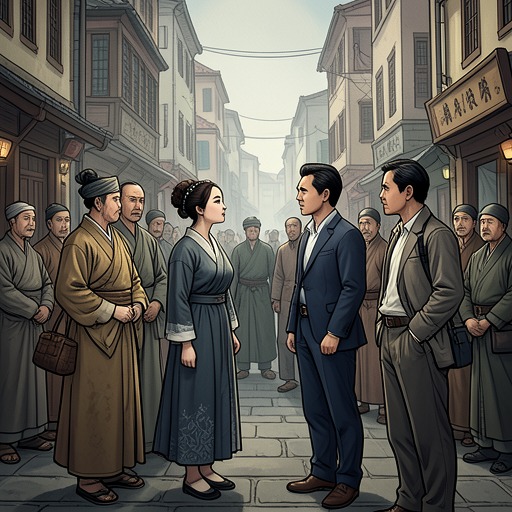
Jin Zhengnan
CEO's Beloved Honey GirlJin Zhengnan is Su Qingrou’s longtime admirer, trusted companion, and prospective fiancé, but his significance extends beyond the role of a supportive romantic partner. He is repeatedly summoned when Su Qingrou is vulnerable, stands beside her through medical and domestic crises, and openly contrasts his patient devotion with the destructive behavior of Lin Yanche. His presence gives Su Qingrou an alternative to the coercive and unstable relationships dominating the surrounding plot, while the proposed engagement between them also carries the practical weight of an alliance between their companies.
Identity and Introduction
Jin Zhengnan first enters the immediate circle around Su Qingrou as the person she calls to accompany her when Su Xiangwan is preparing to leave with Lu Xun. Su Qingrou assures Su Xiangwan that she has already contacted Zhengnan and that he is on his way. When Su Xiangwan later introduces him to Lu Xun, she identifies him as her sister’s best friend and addresses him as Brother Jin, establishing a relationship grounded in long familiarity and family trust rather than a recent courtship.
That introduction also places Jin Zhengnan within the complicated social hierarchy surrounding Su Qingrou and Su Xiangwan. He is close enough to be invited into private family situations, yet he is not merely a neutral friend. Later evidence makes clear that his attachment to Su Qingrou has lasted for more than a decade. His romantic interest therefore predates the immediate crises of the plot and explains why his care appears habitual, sustained, and emotionally invested rather than opportunistic.
Care Through Illness and Crisis
Jin Zhengnan’s loyalty is most concretely expressed through practical care. When Su Qingrou is taken to the Hospital and waits outside the operating room in tears, Jin Zhengnan is the person who emerges afterward to confirm that everything is all right. Su Xiangwan leaves only after Jin Zhengnan has provided that reassurance. The episode makes him a stabilizing presence at a moment when fear has reduced the family to waiting for medical news.
His role continues after the operation. When Su Xiangwan visits the Hospital looking for him, Bian Jiang is the only person present because Jin Zhengnan has not appeared, and Jin Zhengnan later says that he is about to leave the Hospital. The scattered details suggest a period of continuing medical concern rather than a single dramatic intervention. Su Qingrou’s condition remains important to the people around her, and Jin Zhengnan is repeatedly associated with the effort to monitor it.
His concern becomes especially visible when Su Qingrou has suffered a high fever. He explains that she has only recovered that morning and that her sister has been so worried that she has not slept for two days, then passes a bowl of porridge to Su Xiangwan. The gesture is modest but revealing: Jin Zhengnan does not respond to illness with grand declarations alone. He notices exhaustion, supplies food, and helps redirect care toward the people who have been caring for Su Qingrou.
Jin Zhengnan also knows Su Qingrou’s ordinary weaknesses. He understands that once she becomes busy, she neglects to eat, so he calls her in the morning, at midday, and late at night to remind her to have meals. This recurring routine gives his affection a domestic form. It is not limited to moments when she is visibly ill; it operates as sustained attention to the small habits through which illness, overwork, and emotional strain can deepen.
Devotion, Rivalry, and Conflict
Jin Zhengnan’s devotion is measured against Lin Yanche’s conduct. In a confrontation, Jin Zhengnan speaks of being injured and emotionally hurt, yet says that even victory would bring him no pleasure and would only worsen his internal injuries. He then mocks Lin Yanche’s moral failure, arguing that Lin Yanche’s behavior made it possible for Su Qingrou to recognize Jin Zhengnan’s kindness and accept his pursuit. The speech transforms the romantic rivalry into an ethical contrast: Lin Yanche is associated with cruelty and damage, while Jin Zhengnan presents himself as the man whose patience has been visible for years.
His claim that he has loved Su Qingrou for more than a decade gives the conflict unusual temporal depth. Jin Zhengnan is not simply competing for a woman after a recent breakup; he is asserting the legitimacy of a feeling that has endured through the entire period in which Su Qingrou’s attachment to Lin Yanche has shaped her life. His grievance therefore contains both jealousy and accumulated emotional debt, since long waiting has become part of the meaning he assigns to his devotion.
The wider family repeatedly recognizes this contrast. Lu Xun encourages Su Xiangwan to learn from Su Qingrou and Jin Zhengnan, presenting their flirtatious intimacy as an example of what ordinary couples do. Whether or not the comparison is entirely fair, it shows that Jin Zhengnan and Su Qingrou are read by others as a visible model of mutual closeness. Their relationship becomes a social reference point within the turbulent marriages and rivalries around them.
Jin Zhengnan’s connection with Su Qingrou also intersects with the Lin Clan’s hostility. When Su Xiangcheng arrives at a hotel and sees that Su Qingrou has brought Lin Yanche, the sight darkens the atmosphere before the later confrontations. In another episode, Lin Yancheng breaks into Su Qingrou’s bedroom and finds her in pajamas while Jin Zhengnan is standing inside. The scene places Jin Zhengnan directly within the charged domestic space claimed and contested by Lin Yanche. His presence is not merely protective; it becomes evidence in the ongoing struggle over who has the right to stand beside Su Qingrou.
Engagement and Public Alliance
Jin Zhengnan’s relationship with Su Qingrou eventually acquires a formal and strategic dimension. After negotiations with members of the Lin Clan conclude, Su Qingrou reflects that a boss can employ many workers but that the Lin Clan is as difficult to handle as Lin Yanche himself. Against this background of corporate pressure, she proposes that she and Jin Zhengnan hold a small engagement ceremony first, mainly for the benefit of their two companies, and asks what he thinks.
The proposal does not erase the emotional history between them. Instead, it joins private affection to public necessity. Their possible engagement can strengthen the position of both companies while also offering Su Qingrou a relationship not defined by Lin Yanche’s instability. The ceremony is described as small and initially motivated by business interests, which preserves an important ambiguity: Jin Zhengnan’s feelings are personal and longstanding, while the formal arrangement is also part of the family and corporate contest surrounding the couple.
The proposed engagement thus embodies the novel’s recurring overlap between romance and power. A bond that began in friendship and long-term admiration is drawn into negotiations among the Su Family, the Lin Clan, and the broader business world. Jin Zhengnan is valuable to Su Qingrou both because he loves her and because his alliance can alter the balance of those external conflicts.
Change, Limits, and Narrative Role
Jin Zhengnan’s movement through the story is not defined by a single spectacular transformation. His development lies in the increasing visibility of qualities that were present from the beginning: reliability, attentiveness, endurance, and a willingness to remain close when Su Qingrou is sick, frightened, or entangled in family conflict. The narrative repeatedly tests these qualities against the more dramatic force of Lin Yanche’s possessiveness, and Jin Zhengnan’s relative steadiness becomes meaningful precisely because it is expressed through repetition.
He is also a character whose emotional position contains both strength and vulnerability. His care gives Su Qingrou tangible support, but his long unrequited attachment leaves him exposed to comparison with Lin Yanche and to the possibility that marriage may be organized partly for corporate purposes. His own account of internal injury makes clear that kindness does not protect him from pain; it only gives that pain a different moral shape from the violence surrounding him.
By the later movement of the plot, the narrative places Su Qingrou and Jin Zhengnan in relation to Yan City as well as Cloud City. Their absence from Cloud City complicates efforts to find them, and the suggestion that Yan City may suit Su Qingrou better than the troubled region of Cloud City gives their relationship a possible spatial alternative. Jin Zhengnan’s importance therefore rests not only in what he does for Su Qingrou in crisis, but in the possibility that his steady companionship could help her move beyond the destructive emotional and political environment that has governed her previous choices.
Jin Zhengnan functions as both character and counterexample. He represents a form of love that is persistent without being presented as openly coercive, practical without being emotionally empty, and intimate enough to enter family life while still capable of serving corporate interests. The story does not reduce him to a flawless savior: his rivalry is bitter, his devotion carries resentment, and his proposed engagement is entangled with business strategy. Yet those contradictions make him more than a flat romantic alternative. His central narrative purpose is to show what Su Qingrou’s life might look like when care is measured not by possession or spectacle, but by endurance, nourishment, accompaniment, and the repeated decision to remain present.